Showing posts with label Social Justice. Show all posts

Sunday, November 30, 2014

Advent Needs a New Thought


This blog series on Advent was sparked by a post on Facebook of an Advent music video entitled “Waiting for Jesus.”  Waiting for Jesus?  Waiting?   When I look out into the world today and hear the cries of oppression, injustice and abuse - it occurs to me that Jesus (and more accurately The Christ Light) is waiting on us!

Advent (from the Latin word adventus, meaning "coming") is considered to be the beginning of the Church Year for most churches in the Western tradition. It begins on the fourth Sunday before Christmas Day, which is the Sunday nearest November 30, and ends on Christmas Eve (Dec 24).

The season is for most Christians one of anticipation and hope (if one looks beyond the commercialism!), although at its beginnings the emphasis was much more on penitence, fasting and sin. For most Christians it is not just a journey to the birth of Jesus, but also a story of anticipation for his “second coming.”

As I watch the news of the latest developments in Ferguson, MO and the many marches and protests happening nationwide in response to the Grand Jury announcement on the tragic death of Michael Brown, I realized that Advent needs a New Thought.

Advent is a ritual that has little to do with the actual birth of Jesus.  Rather it reinforces a faith story in those that participate and as such takes on symbolic meaning.  It is in this symbolic meaning of the journey that I find real Hope that transformation can come for those who are willing to walk the story in a new way.  My intention is to offer a new walk into the Christ Light that dissipates the darkness of our present day conditions.

Week 1: Hope

“Oh, that you would rend the heavens and come down” - Isaiah 64:1

This is the plea of the prophet Isaiah in chapter 64, verse 1. How often have our hearts prayed for the same? How often have we longed for God to break into this broken world and set right the wrongs?  How often have we wished for some Divine intervention to rescue us from a seemingly hopeless and dark time?  We’ve all prayed that prayer: “Come and make it right, God. Step in and do something about this mess.”

This Cry of the hopeless, the cry of the oppressed, downtrodden, forgotten, unseen and unheard.  Historically the Cry, when heard, initiates a path of restoration.

But the path of restoration, while told often in dramatic tales of spiritual heroism (Moses leading his people out of slavery), is ultimately a path that must unfold through human consciousness.  In other words, it develops as we develop.  “God can only do for us, what God can do through us”, and each of the heroic tales of redemption illustrate that.

This same passage in Isaiah reminds us of this;

Yet, O LORD, you are our Father; we are the clay, and you are our potter; we are all the work of your hand.  - Isaiah 64:8

If we are the clay and the work of the hands of the Divine, then God’s response to the cry of the oppressed is acted out through OUR response to the cry of the oppressed.  WE ARE THE RESPONSE.

Yet it is easy to see why we often don’t think we are the response and that we instead, wait, hope and long for a divine intervention.

This cry is ancient.  Throughout history deep and horrific abuses of human life and dignity have been suffered by some group at the hands of the powerful and greedy.   Many times over the moment has come when it is too much to bear any longer and a deep aching cry bellows out.

At this point in our journey, it is important to remember that our spiritual walk is not separate from our human development walk, they are intertwined.

As human beings, before we are born (Garden of Eden) into the world of effects (Tree of Knowledge), all of our needs are met, even before we know we have a need.  Then we are born and the cry to be comforted begins and we set out on a life long journey of learning how to fulfill our needs.  In the early stages our needs are met as signaled by our cry, through external means (caregivers).  Overtime we learn to develop skills and resources to meeting our own needs, by answering our own call (message of Jesus - seek Kingdom within).

Collectively then, we have throughout history projected that some outside help will rescue, fix, heal, or meet our need.  “Moses will lead us” “Jesus will save us” are stories of projection.  Yet the objects of projection (the spiritual hero we put all our hopes on), all turn out to be teachers of reflection.  In every case either implicitly or explicitly they require that “the followers” turn within to find the real power and ultimate answers.

The tragic death of Michael Brown and the ensuing abuses of the legal system touched a deep wound in America.  A wound as old as our country.  A wound that says people of color don’t matter.  A wound perpetuated by deliberate actions of casting Native Americans aside, stealing their land, breaking promises, robbing them of their culture and denying them their dignity.  Over and over a message that says “I don’t see you, I don’t hear you.  You don’t matter to me.” A message repeated to women, African Americans, Asian Americans, Mexican Americans, gays, lesbians and transgendered people.

“I don’t see you, I don’t hear you, You don’t matter to me” if repeated in words and deeds to a child repeatedly and systematically would cause severe psychological damage and  trauma to the child’s emotional and physical health.

This is exactly what we are dealing with in the Ferguson case, it is the latest in a series of sparks that ignite the deeper cry of a people who have systematically and repeatedly been told “I don’t see you, I don’t hear you, your life does not matter to me”

And so once again in our history, people have taken to the streets.

“Riots are the language of the unheard” - Dr. Martin Luther King Jr.  

This cry is not for a messiah to come down from the heavens or even for a King to emerge from the streets and walk to the front of the marches.  This cry is for you and me to hear and respond.

I invite us to return to Isaiah and remember that we are the clay, God is the potter and we are the works of the hands of the Divine.

Mark Nepo tells of an ancient story in which

“ a group of pilgrims searching for the holy land. They wandered for days to the bank of a very wide river. It was too deep to cross, and there was nothing to build with. One of the pilgrims prayed for guidance, and a voice appeared urging each to give up something they held dear. From this they could build a raft. For only that which they held dear would be strong enough to hold them up as they crossed into the holy land.
There was immediate conflict and suspicion. The one who heard the voice was accused of trying to steal what mattered most to everyone. Finally, four of the stranded pilgrims agreed. Each offered what seemed useless to the others: a stone, a feather, a piece of driftwood, a page from a book no one understood. Mysteriously, as they slept, the dearness they had placed in these things flowed together and they woke to find a magnificent raft.
Once on the other side, the one who gave up the feather heard another voice. It said that the holy land was right where they had landed. The four pilgrims settled on the far bank within view of the others[…]”
Excerpt From: Mark Nepo. “The Book of Awakening.” 

When we lead with what we hold dear - we are acting on a spiritual maturity that no longer expects Divine Intervention from beyond - but rather understands that beyond our fears there is an internal Divine source that we can and must bring forth to get to the other side.

“If you bring forth what is within you, what you bring forth will save you. If you do not bring forth what is within you, what you do not bring forth will destroy you.” - Gospel of Thomas

We saw a great example of this right here in Portland during the peaceful demonstrations…

Portland Police Sgt. Bret Barnum hugging 12-year-old Devonte Hart during the Ferguson demonstration in Portland on Nov. 25, 2014.
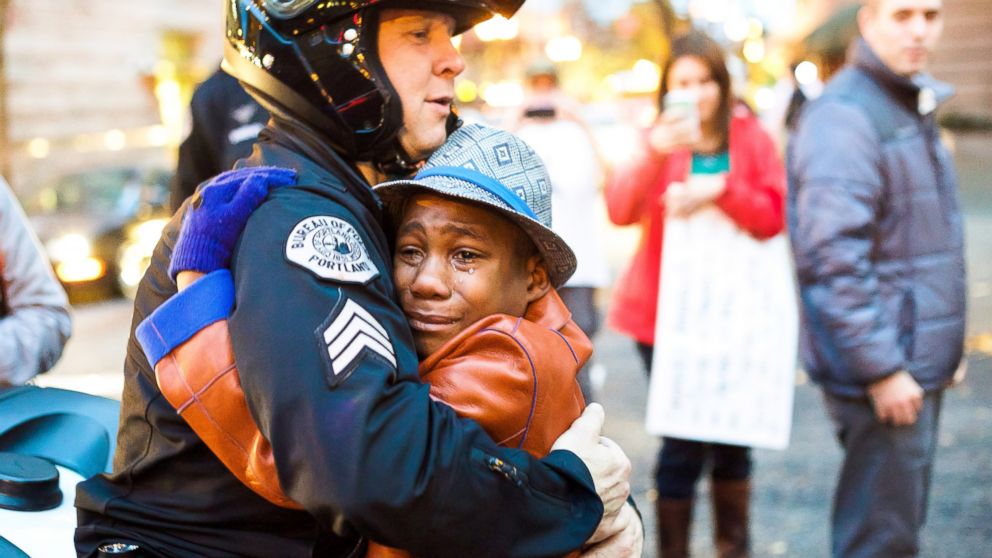


According to Sgt. Barnum, the interaction took place at the beginning of the rally. With emotions running high as speakers were addressing the crowd, he noticed a young man with tears in his eyes holding a "Free Hugs" sign among a group of people.

Sgt. Barnum motioned him over and the two started talking about the demonstration, school, art and life. As the conversation ended, Sgt. Barnum pointed to his sign and asked, "Do I get one of those?" The moment following his question was captured in the photo above, which shows Devonte's eyes welling up with tears once again as he embraces the officer.  (source Oregonian) 

Even more remarkable is where this young man came from:
Devonte Hart entered the world 12 years ago with drugs pumping through his tiny newborn body.  By the time he was 4 years old he had smoked, consumed alcohol, handled guns, been shot at, and suffered severe abuse and neglect.
He knew only a handful of words, including fuck and shit, and he struggled to identify with the names of food, body parts and every day objects. Devonte was a violent toddler and his health was weighed down by a heavy list of disabilities.
It was a life with little hope and a future that seemed over before it began.   (source; Paper Trail) 

He was another victim of the old wound “I don’t see you, I don’t hear you, your life does not matter”

That is until Jen Hart and her wife Sarah entered Devonte’s life and adopted him and his two siblings seven years ago.
“I felt more connected to this fragile little boy more than I had ever felt to anyone in my life.”  She had the courage to lead with what she held dear - and inner knowing that his life mattered.
With their unconditional love, nurturing natures, patience and acceptance, Devonte defied all odds and has grown into a young charismatic man with a heart of gold.

As Advent begins we have a choice - we can continue to wait on the world to change by some outside force - or we can being leading with what we all hold most dear, the need to be seen, heard and to know that our life matters, and in doing so, change the world.  

Thursday, July 25, 2013

Finding Our Voice; Social Justice Series part 1

The crafting of a Social Justice voice within and for New Thought / Centers for Spiritual Living is not as easy or as black and white as it may seem.  While our theological doctrine is liberal - our spiritual principles appeal to "conservatives" just as much as they do to "liberals" - politically speaking.  It is the contrast between our rugged individualism and our inherent connection to all life.

Therefore I'm going to have at least 2 entries on this subject (perhaps more if the interest is there).

Part 1 - Will You Sign This?

Recently I was asked by a colleague if I was willing to have a petition signing group at my church.  The petition was for a Marriage Equality Ballot measure.  The individual who asked was seeking guidance as their church had been asked to do this.

The response that followed provided insight into the emerging conversation about the Social Justice voice of New Thought....

Here is my reply:

We've not been asked to do this on Sunday or any future Sunday that I am aware of.

But if  I were, I'd find a way to do it.  (perhaps an open forum and conversation on the issue - after church - that people could freely attend (or not) and the petitions could be available?) 

 I think you could go either way - but it's extremely important to understand your motivation.

 I think it's a valuable opportunity to teach on the Principle of Love.  As you know I believe strongly that New Thought ought to have a place at the table of Social Justice - articulating our own unique voice ... in fact I believe that doing so would greatly change (for the better) the overall tenor of Social Justice work (ie our voice is missing and it shows!)

There are many angles you could take on this to teach....

Dr. Cornel West says it best:  "Justice is what love looks like in public"  - to me, Marriage Equality is about taking a stand for the Principle of Love and the equality of the law being applied to all.  

As for engaging in the political process - a few thoughts...

1. the law is clear that 501c3's cannot endorse candidates - that's the big no-no!  But you can register people to vote and sign petitions on ballot measures if you choose.

 - The Community of Welcoming Congregations hosted a petition signing event for this ballot measure earlier this year for clergy - I was among the first to sign.

- The religious right understands the law and takes advantage of it (not that I favor what they do - but man are they clear and organized!) - the religious left is mostly afraid of the either the law or afraid of offending some of their members - (the religious right does not have this problem), those who tread forward can end up looking like "liberal zealots" (of which we have within our centers - but I would say don't want to characterize all of New Thought or CSL as such) 

2. I don't see this as a "political issue" but as a spiritual principle one.    We teach that "demonstration is the only authority" - so where is the demonstration that Love is all there is and equally available to all?  And if it is not currently demonstrated in our society - how will that change?  If not by our own inner conviction and active demonstration?

- of course the easy answer here lies in Individual choice.  Everyone has to have their own demonstration and thus act accordingly.  True enough.    WIthin this angle you could encourage folks to act on their own inner convictions.  We are after all a fiercely independent teaching.  I think this approach is 99% right, and is applicable to most issues.  There is the slippery slope of allowing "one type" of social issue - opening the flood gates to every social cause needing platform time and sign-ups in the back of church... soon you are the social activism church (ie Unitarians, which we are not [with all due respect to my Unitarian friends and colleagues] ).   The approach of Individual action helps avoid that slope.  

However, there are exceptions (the absolutist out there are gonna go nuts about now...).  Exceptions where "the church" ought to have a voice in the social state.  Civil Rights is one of them.  Marriage equality is not only a spiritual principle issue - it is THE Civil Rights issue of our time.  First and foremost, I don't believe that civil rights should every be put to a public vote, but if that is method we must employ to gain acceptance of this as a basic civil right - then so be it.  

"The Church" cannot afford to remain silent in the face of basic civil rights violations/discrimination.  Especially a movement that speaks of Oneness and universal Love and creating a world that works for everyone.  

The truth of this issue is this - both democrats and republicans, independents, libertarians and tea party people should be voting FOR civil rights of ALL people.  The religious right has been very successful in framing this issue as being liberals vs conservatives, sinners vs religiously moral people, acceptance of 'gay lifestyle' vs 'traditional family values'   - But the truth is one does not need to be "in favor" of "gay lifestyle" (whatever that is) in order to vote in favor of basic civil rights.  A mature society recognizes that you don't have to "like" or even "accept" the choices or behaviors of your neighbor in order to acknowledge that they have the right to make those choices.  

But that wisdom has gotten lost in the fervor of "religious morality" and right vs wrong and liberals vs conservatives. - which is exactly the way the religious right wants it to be thought of.

The only way to change that is for the liberal religious voices of our society to speak up and reclaim the conversation as one of basic human rights, dignity and worth and speak to the transcendent spiritual ideals that supersede political affiliation - i.e. Equality and Justice for All.


I shared the following at the luncheon that CSL sponsored at The Fellowship of Affirming Ministries conference in Las Vegas last week - "We (CSL) don't want to partner with you to "save or fix" the world.  Rather we want to partner with you to REVEAL a world that already exist in the Mind of God and recognize that we must stand with you to work and build it together." 

"It is quite a burden lifted when we realize that we do not have to move the world-it is going to move anyway. This realization does not lessen our duty or our social obligation. It clarifies it. It enables us to do joyously, and free from morbidity, that which we should do in the social state."
Emphasis added
pp. 270, The Science of Mind, by Ernest Holmes

Thus I choose to freely and joyously teach Love and stand for it in the public square.


Rev. David Alexander

Thursday, November 10, 2011

Occupy Movement: Phase 2: Now What?

The Mayor of Portland OR - just announced that he'll be having the Occupy Protestors removed from the city park soon (click here for the press release).

Similar action is occurring around the country and it seems that the Occupy Movement has gained all that it can from the "sit in" strategy. So, what is next? Where does the movement go from here? Before I answer that - let me explore some thoughts on where we are at from a New Thought perspective.

I believe that the Occupy Movement arose from a consciousness that was "fed up" - tired and weary of the inequity of our world. Similar uprisings in the Middle East - the so called Arab Spring - arose from a similar place in consciousness, a desire to be heard, seen and validated as a being of significance in the world. This is a universal desire - something that we all want. We all have the need to be heard, seen and feel as if we matter to the world - that our presence makes a difference and that we live in a world where we are empowered and can direct our life with purpose. Whenever one wakes up to the awareness that they have been oppressed or suppressed the natural desire is "take control" to make one's presence known and felt. Once this occurs, the door opens to the next step - to take restorative action. But before restorative action can take place there must be a grounding in a greater awareness of who we really are. Without this grounding restorative action turns to reactionary and retaliation action. This is the difference between effective social change movements and ineffective ones. Let me give you a few examples:

1 The Tea Party - This group actually tapped into the same collective frustration and feelings of oppression and suppression that the Occupy Movement did. In doing so they were able to quickly turn this frustration into action in the form of election of "Tea Party" platform candidates. All of this is part of "Phase 1" of social change: Frustration, Awakening, Get Noticed (ie "Take Control").
 
However, the Tea Party failed to get grounded in a greater awareness and inclusive vision of who and what we are as a human family. In fact, much of the early Tea Party support was actually funded and organized by those with a divisive agenda. And it was this more divisive agenda and vision of "us vs them" that the movement was grounded in. As a result, potential restorative action turned to reactionary action - in the form of "obstructive politics" and most recently by ballot measures and policy platforms that only served to deepen the gap between "us and them." The result on election night 2011 was major defeat and rejection of Tea Party candidates and ballot measures. A house divided against itself cannot stand. The Tea Party believed that they could take the general frustration and disenchantment of the people and turn it into support for divisive politics and policies. They were wrong. And the reason is simple: It is a universal principle that all dissonance seeks to resolve itself in terms of harmony. In other words while the frustration or "dissonance" of the people can be leveraged - it ultimately seeks to resolve itself in terms of greater harmony - not more "us and them."

2. Civil Rights Movement - This movement also begins with a growing frustration, dissonance, inequity and inequality in our culture. The tension builds until there is a spark of awakening which leads to boycotts, marches and site-ins (Get noticed, take control). But this movement becomes grounded in a deep spiritual understanding that we are all in this together - we must make a world that works for everyone. The movement was about Civil rights (grounded in the principle of inclusivity of everyone) not "African American rights"
 
Out of this grounding came the action steps to restore "justice and equality for all." The actions of the movement were restorative in nature. Restoring us to a nation that reflects is highest moral and spiritual values of including everyone in a "single garment of destiny"

The template is made clear - and can be seen throughout history.  In the Bible we read the story of Moses who awakens to the injustices of his world - his reaction? 40 years in the land of Midian as a shepherd - metaphysically meaning that he went within to watch over the flock of his own thoughts and emotions until he receives the insight (burning bush) that where he is standing is Holy Ground and that God's people are destine to be freed to their rightful place. It is from this grounded vision that he then takes action to lead his people (restorative action) to the Promised Land.
 
In the story of Siddartha (Buddha) - he awakens to the inequity, inequality and injustices in his world - outside the walls of his protected palace. His reaction? He sits in...to occupy himself in meditation until the awakening of enlightenment - from which the teachings of Buddhism come. These teachings become the template for restorative action (the Eightfold Path and Four Noble Truths)

The Occupy Movement must now decide which type of movement it is going to be. Phase 1, frustrations over the inequalities and inequity of our systems, has come to an end. The collective attention of a nation has been obtained. The next phase is about action. Will it be restorative action that seeks to unite us in a collective consciousness of the 100% that needs to work together to build a world that works for everyone - or will it be reactionary and retaliation action that continues to divide our world into "us (99%) and them (1%)" categories that must fight each other for supremacy and control?

The answer lies entirely in what type of vision the movement collectively grounds itself in. How the Occupy Movement handles itself in this transition will be the most telling aspect of its destiny. This was captured beautifully by Portland Mayor, Sam Adams in today's press conference:
 "It is my sincere hope that the movement, with its focus on widespread economic inequity, will flourish in its next phase - a phase where we can focus all our energies on economic and social justice, not port-a-potties and tents."
to that end I offer this prayer (an adaptation of the Global Heart Vision of United Centers for Spiritual Living - submitted by my friend Rev. Edward Viljoen):


  • We envision The Occupy Movement as a bridge across the illness and illusion of separation thereby dynamically empowering the vision of Global Heart.
  • We envision The Occupy Movement as united and actuated by this compelling vision of a healthy world (a world experience of Global Heart) and is ardently committed to bringing this vision forth through transformative teachings and democratic action.
  • We see The Occupy Movement as a global community of inspired individuals caring for and about each other and the entire planetary family, thereby bringing the gift of active compassion and kindness to the world. Our Occupy Movements and communities become “points of inspiration and influence” effectively advancing the vision of the Global Heart to benefit all expressions of life.

Followers

Inspired? Thank you for your support